Annuity Lesson #15

2025 Guide to Fixed Annuity Rates

Jeremiah Konger
CEO
"The lower withdrawal rate from investments that corresponds to using an annuity with level payments can help assets to grow and to better manage risks related to market volatility.."
Fixed annuities are considered a low-risk investment for those who want a financial product with predictable rates. Most safe growth annuities offer a guaranteed lifetime income rider that may be a great option for retirees.
However, even fixed annuities are not risk-free. Hence, it’s very important to do your research before investing. One particular factor to pay attention to is fixed annuity rates. Because once you get a fixed-rate annuity, there is not much you can change about it.
In this article, we will explain why annuity rates matter, what factors to consider before investing, and how to choose the right investment for you.
What Are Fixed Annuities?
🔎 A fixed annuity is an insurance contract that promises a fixed rate based on the account’s amount. Depending on the product, an investor can receive a predictable stream of income for life.
In comparison, a variable annuity offers an interest rate that fluctuates based on the performance of your investment portfolio.
With a guaranteed interest annuity, the earnings are tax-deferred, meaning you don’t pay taxes while your principal grows. The taxes apply when you start withdrawing money.
Investing in a fixed-rate annuity offers key benefits like predictable income and guaranteed payout for life or a specific period.
However, investments are not risk-free, and knowing what to expect should help you understand whether a certain annuity is the right fit.
Pros & Cons of Fixed Annuities
Fixed annuities are low-risk investments with benefits suitable for future retirees looking for a guaranteed lifetime income and predictable rates. But low risk means there are some cons you should be aware of.
Today’s Best Fixed Annuity Rates
🔢 Fixed annuity rates range widely based on the insurance provider, term length, your age, and investment amount, among other factors.
Factors That Influence Fixed Annuity Rates
As you can see from the above, fixed annuity rates vary greatly, and they may also fluctuate while you’re thinking about purchasing one. However, you should keep in mind that the interest rate you will receive will highly depend on your current situation.
This means that whatever is written in the offer may not be true for you. Understanding key factors will help you make an informed decision when choosing the right annuity to invest in.
Interest Rate Environment
Fixed annuity rates rise and fall with the broader interest rate market. Insurers invest premiums in long-term bonds, so payouts are tied closely to bond yields and Federal Reserve policy.
👉 What this might mean for you:
Higher rates may offer better guaranteed income opportunities
Waiting for “perfect timing” may risk missing today’s guarantees
By locking in when rates are high, savers may maximize their fixed payouts in the long run. However, retirees who need money right now may not find this investing strategy suitable.
Age and Life Expectancy
Investing in a safe growth annuity may be more beneficial for pre-retirees. This is because the older you are, the more you will have to pay due to the shorter expected payout horizon.
👉 What this might mean for you:
Older retirees can receive substantially larger monthly checks
Younger buyers may feel payouts are too low relative to contributions
Retirees 60+ seeking a reliable lifetime income may find fixed annuities advantageous. These annuities let pre-retirees lock in today’s rates and begin income later.
Gender
Since women generally live longer, annuities for women often pay slightly less than those for men on a single-life basis.
👉 What this might mean for you:
As a woman, you may feel slightly disadvantaged when purchasing a fixed annuity without a joint option
If you consider a joint-life fixed annuity, you may benefit from better and balanced protection for couples, particularly when one spouse is expected to outlive the other.
Payout Option
Your payout structure directly impacts income. More guarantees (joint life, period certain, return of premium) reduce monthly checks, but add security.
👉 What this might mean for you:
Flexible customization for survivor needs or guaranteed terms
Adding more safety features may reduce your monthly payout
Carrier Strength
Each insurer prices annuities differently based on its risk appetite and financial stability. If you see two annuity offers that seem very similar, our advice is to dig further and compare carriers.
👉 What this might mean for you:
By doing proper research, you can shop around for the most competitive rates and reliable company ratings
Contact Length
Some annuities lock in funds for specific time periods. Shorter terms offer flexibility, while longer terms typically reward buyers with higher rates.
👉 What this might mean for you:
If you want to maximize your savings in a short period, a long contract can limit access to your principal
However, MYGAs and fixed terms may help plan for retirement
Fixed annuities can be purchased in advance to align payouts with your retirement timeline. Keep in mind that long-term contracts offer low liquidity and flexibility.
Optional Riders
Riders can enhance annuity contracts with income guarantees, death benefits, or long-term care features. Your payments may also increase with the addition of more riders.
👉 What this might mean for you:
Riders add valuable protection and flexibility
But they also come with additional fees
Fixed Annuities vs. CDs & Bonds
If you want to diversify your portfolio, annuities, certificates of deposit (CDs), and bonds are all worth considering. They are low- to moderate-risk investments that share some similarities.
Fixed annuities are most suitable for retirement-focused savers who want a guaranteed income later in life.
CDs are best for short- to medium-term savers who want safety and predictable returns.
Investing in bonds is a better fit for investors who can tolerate higher risks in return for higher yields.
To see a clearer picture, check this table comparing annuities, CDs, and bonds side-by-side.
How to Choose the Right Fixed Annuity
Choosing an investment with the best fixed annuity rates today is possible if you know how to do it. Here is what we always recommend our clients:
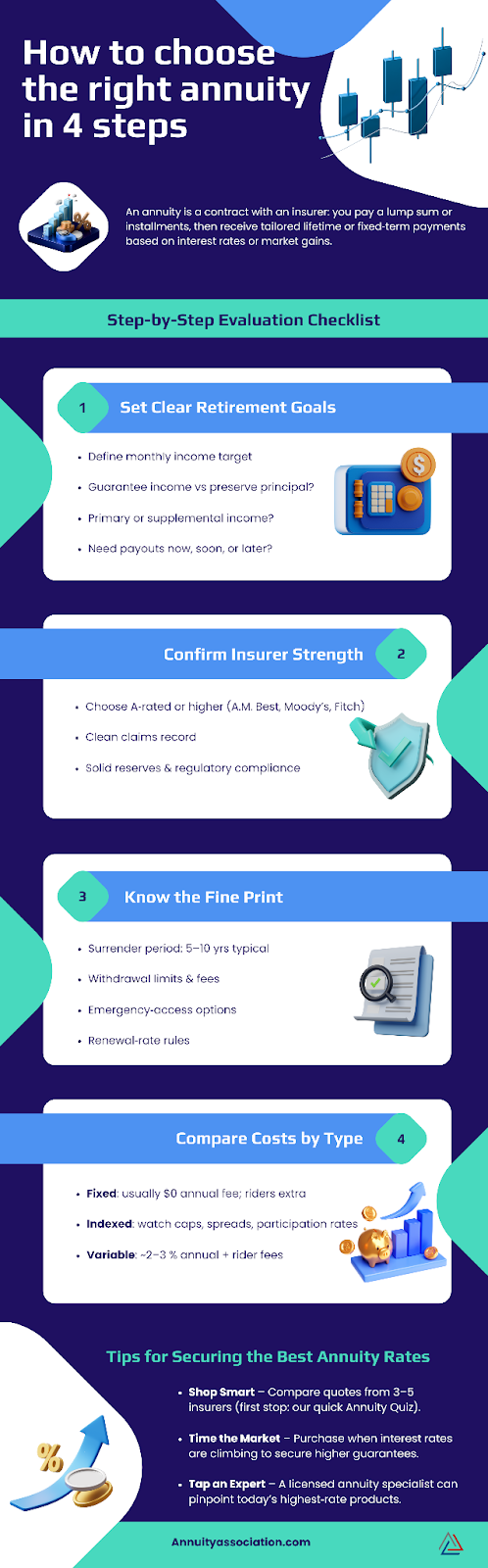
Step 1: Set Clear Retirement Goals
Your first step is to define your income needs. Here is what to consider:
Start date
Monthly/annual income you want
Consider additional riders like inflation protection or legacy/survivor benefits.
Step 2: Confirm Insurer Strength
Before signing the contract, make sure to research the insurer. Here is what to pay attention to:
Check the insurer’s ratings (AM Best, S&P, Moody’s, Fitch) and recent financial statements.
Verify state guaranty limits and the insurer’s claims-paying history
Step 3: Know the Fine Print
Make sure to consult with a financial advisor or check the contract yourself carefully. Here is what to review:
Confirm guaranteed vs. current rates, the length of the guarantee period, surrender period/charges, and whether a Market Value Adjustment (MVA) applies.
Review withdrawal rules, penalty-free amounts, the free-look window, death benefits, annuitization options, and all rider terms and fees.
Step 4: Compare Costs by Type
If you are shopping for a fixed annuity yourself, you should study all your investment options.
Compare MYGAs, deferred fixed annuities, and immediate annuities using the same premium and payout option.
Total the explicit fees and rider charges, and estimate the effective yield after fees and taxes (annuity earnings are tax-deferred). Consider liquidity needs and opportunity cost versus CDs/bonds.
Book a consultation with an Annuity Association advisor to ensure you have the best deal on the market.
Get Personalized Fixed Annuity Rate Quotes
Fixed annuity rates can vary widely depending on your age, contract length, and the insurer you choose. The best way to find the right option is to see customized quotes side by side.
Speak with our expert advisor at Annuity Association or give us a call at (855)-866-3659 to discuss your options today!
FAQs About Fixed Annuity Rates
How often do fixed annuity rates change?
Rates can change weekly or monthly. The rate you lock in applies only to the contract you purchase, not to future buyers.
Are fixed annuity rates guaranteed for life?
Not always. Most fixed annuities guarantee rates for a set term (e.g., 3, 5, or 10 years). After that, the rate may reset, but it can never drop below the contract’s minimum guaranteed rate.
Can I withdraw money early from a fixed annuity?
Yes, but withdrawals beyond the contract’s free-withdrawal allowance (often 10% annually) may trigger surrender charges.
Are fixed annuity rates better than CDs?
Fixed annuities typically offer higher yields than CDs of similar terms, plus tax-deferred growth. However, CDs have FDIC/NCUA insurance, while annuities rely on the insurer’s strength and state guaranty associations.
What happens if interest rates rise after I buy?
Your annuity rate is locked in for the contract term. To stay flexible, some buyers “ladder” annuities, meaning they buy multiple contracts with different terms so they can reinvest at higher rates later.

Annuity Expert
Jeremiah Konger
PS - Here's 3 ways we can help you learn more about annuities.
1. Watch Videos on How to Identify The Highest Paying Protected Income & Growth Annuities.
2. Watch Videos That Reveal What to Look For When Buying A Protected Growth Annuity.
3. Click Here To Access Our Annuity Review Vault To Compare The Pro's and Con's of Dozens of Annuities.
Annuity Association is the leader in providing Independent Annuity recommendations for protected income, safe growth and other benefits in retirement.
-
Serving All 50 States
-
-
Annuity Association
759 SW Federal Hwy Ste 200H
Stuart, FL 34994


© Copyrights 2025 by Annuity Association. All Rights Reseved.